Route flags, context decorators and typed assets in KickJS: declare it once, use it everywhere
How route flags, context decorators and the asset manager combine into KickJS request pipelines that are declarative, typed end to end and hard to get wrong.
Every API accumulates the same kind of glue. "This endpoint is public" gets written three times — once for auth, once for CSRF, once for rate limiting — and two of those are path strings that break the day someone renames a route. "Who is the current user" becomes req.user as any. "Where is the welcome email template" becomes __dirname arithmetic that works in dev and fails in the Docker image.
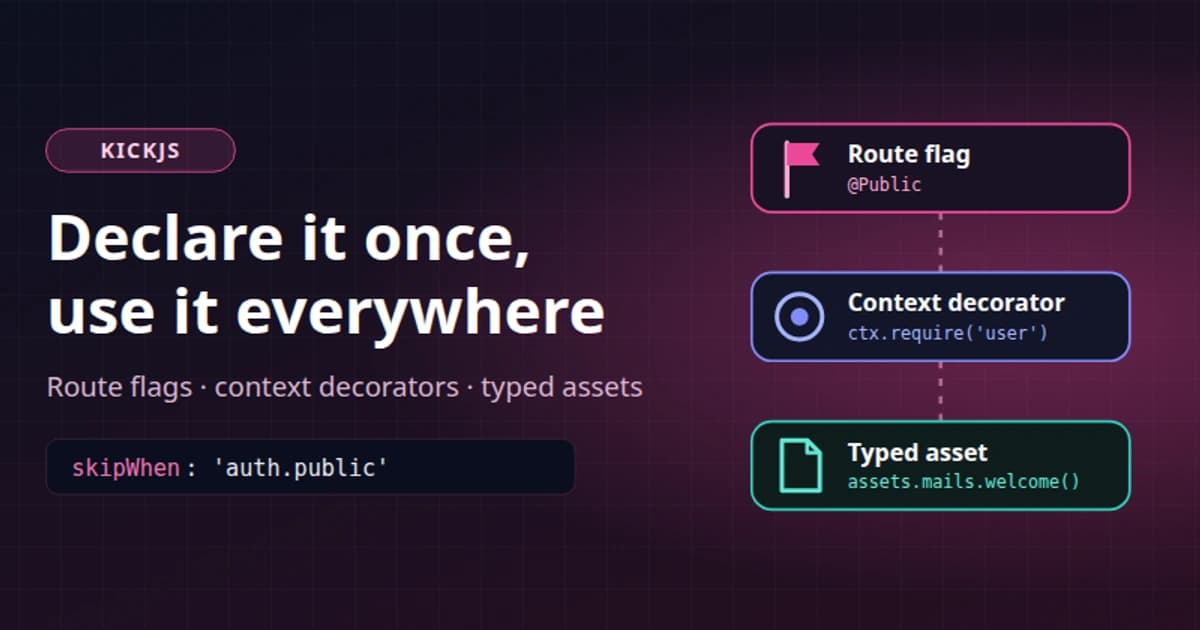
KickJS has three features that remove that glue, and they are far more useful together than apart:
Feature | What it answers | Mental model |
|---|---|---|
Route flags | What is true about this route? | A fact, written once on the route, read by anything. No behaviour. |
Context decorators | What do we know about this request? | A typed value computed per request, before the handler runs. |
Asset manager | Where is that file? | A typed path to a file shipped with your code, correct in dev and in the build. |
This guide explains each one, then builds a small feature set that uses all three at once: public and private routes, a signed-in user, plan-gated endpoints, per-route rate limits, and locale-aware emails and reports rendered from typed templates.
Versions:
@forinda/kickjs8.4+,@forinda/kickjs-cli8.2+,@forinda/kickjs-testing8.0+. All three features are in the core package — nothing extra to install.
1. Route flags: facts about a route#
A route flag is a named, inheritable fact about a route. It does nothing by itself; it records something any consumer can read.
// src/flags.ts
import { defineRouteFlag } from '@forinda/kickjs'
export const Public = defineRouteFlag('auth.public')
export const RateLimit = defineRouteFlag<{ rpm: number }>('rate.limit')
export const Feature = defineRouteFlag<string>('billing.feature')Put flags on a controller, a method, or a module mount. The most specific declaration wins — method > class > mount:
@Public // every route in this controller is public…
@Controller()
export class DocsController {
@Get('/')
index(ctx: RequestContext) {} // public
@Public.off // …except this one
@Get('/drafts')
drafts(ctx: RequestContext) {} // not public
}Read them anywhere you hold a RequestContext — handlers, @Middleware(), guards, contributors:
ctx.route?.flags.has('auth.public') // true / false
ctx.route?.flags.get('rate.limit') // { rpm: 10 } or undefinedTwo rules make flags predictable:
Removal is
.off, never a falsy value. A flag is either present or absent.@Public.offremoves it; there is no "present but false" state that a presence check could misread as "public".falseis a real value. A flag declared with a boolean type can storefalse, andflags.get()returns it. Only.offremoves.
ctx.route is undefined in global middleware, which runs before a route is matched (section 8 shows how pre-routing middleware reads flags anyway).
2. Context decorators: typed values about a request#
A context decorator (also called a contributor) computes a value from the request and stores it on the context before the handler runs. It replaces middleware whose only job was "compute X and stash it on the request".
Scaffold one:
kick g contributor locale --dry-runkick g contributor locale -o src/contributorsFill it in:
// src/contributors/locale.contributor.ts
import { defineHttpContextDecorator } from '@forinda/kickjs'
// 1. Declare the key's type once, for the whole app.
declare module '@forinda/kickjs' {
interface ContextMeta {
locale: { language: string; region: string | null }
}
}
// 2. Define how it's computed.
export const ResolveLocale = defineHttpContextDecorator({
key: 'locale',
resolve: (ctx) => {
const header = (ctx.req.headers['accept-language'] as string | undefined) ?? 'en'
const [language, region] = header.split(',')[0].trim().split('-')
return { language: language.toLowerCase(), region: region ?? null }
},
})Use it:
@ResolveLocale
@Get('/home')
home(ctx: RequestContext) {
const locale = ctx.require('locale') // { language: string; region: string | null }
}What you get over hand-written middleware:
Concern | Middleware | Context decorator |
|---|---|---|
Type of the value |
|
|
Ordering | Array position in |
|
Services |
|
|
Per-route opt-out | Fork the stack or check paths |
|
Errors | Throw → 500 |
|
Testing | Whole HTTP stack |
|
Registration sites, highest precedence first: method > class > module contributors() > adapter/plugin contributors() > bootstrap({ contributors }). A narrower registration of the same key silently replaces a broader one.
Reading values:
ctx.require('key')— for values the route must have. ThrowsMissingContextValueErrornaming the key and route if the contributor didn't run. Never writectx.get('key')!: it compiles even after someone deletes the decorator.ctx.get('key')— for optional extras. ReturnsT | undefined.getRequestValue('key')— from a service with noctxin scope. Returnsundefinedoutside a request.
Always return the value from
resolve(). Assigningctx.locale = …writes to one internal context object that the handler never sees.
3. The asset manager: typed paths to your files#
Templates, report layouts, JSON schemas and fixtures live next to your code in development and get copied somewhere else in the build. Without help, every call site does this:
const path =
process.env.NODE_ENV === 'production'
? join(__dirname, '../templates/mails/welcome.ejs')
: join(__dirname, '../../src/templates/mails/welcome.ejs')Typos compile, every call site branches on the environment, and __dirname breaks under ESM and bundling.
Configure
Tell the CLI which directories hold assets, in kick.config.ts:
import { defineConfig } from '@forinda/kickjs-cli'
export default defineConfig({
assetMap: {
mails: { src: 'src/templates/mails', glob: '**/*.ejs' },
reports: { src: 'src/templates/reports', glob: '**/*.{ejs,html}' },
schemas: { src: 'src/schemas', glob: '**/*.json' },
},
})Each entry takes src (required), dest (default dist/<name>/), glob (default **/*) and keys ('auto', 'strip' or 'with-extension' — how file names become property names).
Generate types
kick typegen # kick dev runs this automatically on every changeFor a file tree like:
src/templates/mails/en/welcome.ejs
src/templates/mails/fr/welcome.ejs
src/templates/reports/monthly.ejs
you get a typed surface:
import { assets } from '@forinda/kickjs'
assets.mails.en.welcome() // absolute path to the right file, dev or build
assets.reports.monthly()
assets.mails.en.welcom() // compile errorFour ways to read an asset
All four go through the same cached resolver:
import { assets, useAssets, Asset, resolveAsset } from '@forinda/kickjs'
assets.reports.monthly() // 1. ambient proxy — the default
class ReportService {
private assets = useAssets() // 2. as a field — easy to mock in tests
}
@Service()
class InvoiceService {
@Asset('reports/invoice') // 3. declarative field, resolved on each access
private invoiceTemplate!: string
}
resolveAsset('mails', 'fr/welcome') // 4. dynamic — names known only at runtime; throws UnknownAssetError on a missIn the build
kick build copies every assetMap entry into the output directory, writes a manifest (.kickjs-assets.json) and runs typegen. At runtime the resolver uses that manifest when it exists, and walks your src directories when it doesn't — so the same assets.mails.en.welcome() call works in kick dev and in production. After adding a template in dev, kick build:assets refreshes the manifest without a full rebuild.
4. How they fit together#
The three features form a natural pipeline for any request:
route matched
│
├─ route flags resolved (method > class > mount) "what is true about this route"
│
├─ contributors run, in dependsOn order "what we know about this request"
│ • skipWhen / onlyWhen read the flags
│ • resolve() can read ctx.route.flags values
│ • guards read flags via exemptWhen
│
└─ handler / services
• ctx.require(...) / getRequestValue(...)
• assets.* picks the file, often chosen by a contributor value
The division of labour that keeps codebases clean:
Flags describe — "public", "needs the reports feature", "limit 10 rpm". Declarative, inheritable, visible in the route list.
Contributors decide — load the user, load the plan, check the feature, compute the locale. Typed, ordered, testable.
Assets deliver — the template or schema the decision points at, with a path that is always right.
The recipes below build that pipeline piece by piece.
5. Recipe: one "public" flag, every consumer#
Declare the fact once:
// src/flags.ts
export const Public = defineRouteFlag('auth.public')Put it on routes:
@Public
@Controller()
export class AuthController {
@Post('/login') login(ctx: RequestContext) {}
@Post('/register') register(ctx: RequestContext) {}
@Public.off // the only private route here
@Get('/me')
me(ctx: RequestContext) {}
}Now every consumer reads that one declaration instead of its own path list:
// Auth: the user contributor steps aside on public routes (section 6).
skipWhen: 'auth.public'
// CSRF and rate limiting, as route guards:
@Middleware(csrfGuard({ exemptWhen: 'auth.public' }))
@Middleware(rateLimitGuard({ max: 60, exemptWhen: 'auth.public' }))
// OpenAPI: public routes show no lock icon.
SwaggerAdapter({ bearerAuth: true, publicFlag: 'auth.public' })
// The built-in health probes, which you don't own:
bootstrap({ health: { flags: ['auth.public'] } })Rename a route, change the API prefix, add /users/:id — nothing breaks, because nothing matches on path strings. And DevTools shows each route's resolved flags in its Routes tab, so "why is this endpoint open?" is answered from the route list.
The framework names no flags.
auth.publicis a name you chose — pick a namespace per concern (auth.*,billing.*,rate.*) so readers can tell who consumes a flag.
6. Recipe: the signed-in user, skipped on public routes#
// src/contributors/load-user.contributor.ts
import { defineHttpContextDecorator, HttpException } from '@forinda/kickjs'
import { SESSIONS } from '@/auth/sessions'
declare module '@forinda/kickjs' {
interface ContextMeta {
user: { id: string; accountId: string; roles: string[] }
}
}
export const LoadUser = defineHttpContextDecorator({
key: 'user',
skipWhen: 'auth.public', // the flag from section 5
beforeValidation: true, // answer 401 before 422
deps: { sessions: SESSIONS },
resolve: async (ctx, { sessions }) => {
const user = await sessions.fromToken(ctx.headers.authorization)
if (!user) throw HttpException.unauthorized()
return user
},
})Register it once, app-wide:
bootstrap({ modules, contributors: [LoadUser.registration] })Every route now requires a user, except routes flagged public. Three details matter:
skipWhenmakes exemption work across ownership. Without flags, the only way to opt a route out of a contributor is to register a permissive twin under the same key — which you can't do for a contributor a plugin shipped. A flag lives on the route, so you can exempt anything.beforeValidation: truemoves the contributor ahead of body validation. Otherwise an anonymous request with a bad body gets a422listing your schema. The order becomesbeforeValidation contributors → validation → @Middleware() → other contributors → handler. Read headers and cookies here, never the body — it isn't validated yet.A skipped contributor sets no key. On routes that can be public, read
ctx.get('user'); usectx.require('user')only where the route is guaranteed private.
Services that need the user don't take it as a parameter:
@Service()
export class AuditService {
record(action: string) {
const user = getRequestValue('user') // typed, undefined on public routes
this.log.insert({ action, userId: user?.id ?? null })
}
}7. Recipe: plan-gated routes with a flag value and dependsOn#
Goal: some routes require a paid feature. The route states which feature; contributors enforce it.
The flag carries a value:
export const Feature = defineRouteFlag<string>('billing.feature')Load the account's plan after the user:
// src/contributors/load-plan.contributor.ts
declare module '@forinda/kickjs' {
interface ContextMeta {
plan: { name: 'free' | 'pro' | 'enterprise'; features: string[] }
}
}
export const LoadPlan = defineHttpContextDecorator({
key: 'plan',
dependsOn: ['user'], // runs after LoadUser; boot fails if nothing produces 'user'
skipWhen: 'auth.public',
deps: { billing: BILLING },
resolve: async (ctx, { billing }) => billing.planFor(ctx.require('user').accountId),
onError: () => ({ name: 'free', features: [] }), // billing down → treat as free, don't 500
})Enforce the feature only where a route asks for one:
// src/contributors/require-feature.contributor.ts
declare module '@forinda/kickjs' {
interface ContextMeta {
feature: string
}
}
export const RequireFeature = defineHttpContextDecorator({
key: 'feature',
onlyWhen: 'billing.feature', // routes without the flag skip this entirely
dependsOn: ['plan'],
resolve: (ctx) => {
const needed = ctx.route?.flags.get('billing.feature') // the flag's value, e.g. 'reports'
const plan = ctx.require('plan')
if (!needed || !plan.features.includes(needed)) {
ctx.problem.forbidden({
type: 'https://example.com/probs/upgrade-required',
detail: `This needs the ${needed} feature, which is not on the ${plan.name} plan`,
})
}
return needed
},
})Register the chain app-wide:
bootstrap({ modules, contributors: [LoadUser.registration, LoadPlan.registration, RequireFeature.registration],})Now gating a route is one line, and it reads like documentation:
@Controller()
export class ReportsController {
@Feature('reports')
@Get('/monthly')
monthly(ctx: RequestContext) {} // pro and above
@Get('/summary')
summary(ctx: RequestContext) {} // everyone signed in
}Why this shape works:
Order is declared, not arranged.
dependsOngivesuser → plan → feature. ForgetLoadUserand the app refuses to start withMissingContributorErrorinstead of failing on the first request.Cost is paid only where needed.
onlyWhenmeans routes without the flag never evaluate the check; a skipped contributor costs a map lookup.Errors keep their shape.
ctx.problem.forbidden(...)answers RFC 9457application/problem+jsonfrom inside a contributor, so clients can branch ontype.The fallback is explicit.
onErrorreturns a value; the runner stores it under the key.
8. Recipe: per-route rate limits from one declaration#
A flag with a value, read by several consumers:
export const RateLimit = defineRouteFlag<{ rpm: number }>('rate.limit')
@RateLimit({ rpm: 10 })
@Post('/login')
login(ctx: RequestContext) {}Inside the route — a guard can exempt unmetered routes with a predicate that reads the value:
@Middleware(
rateLimitGuard({
max: 60,
exemptWhen: ({ flags }) => flags.get('rate.limit')?.rpm === 0,
}),
)A contributor can derive the limiter key and window from the same flag:
declare module '@forinda/kickjs' {
interface ContextMeta {
rateLimit: { key: string; rpm: number }
}
}
export const RateLimitKey = defineHttpContextDecorator({
key: 'rateLimit',
onlyWhen: 'rate.limit',
resolve: (ctx) => ({
key: `${ctx.get('user')?.id ?? ctx.req.ip}:${ctx.route?.path}`,
rpm: ctx.route?.flags.get('rate.limit')?.rpm ?? 60,
}),
})Before routing — app-wide middleware has no ctx.route, so it reads a policy table the app builds at boot from every mounted route's method, path and flags:
bootstrap({ middlewares: [rateLimit({ max: 60, exemptWhen: 'auth.public' })] })Your own pre-routing middleware can read the same table:
import { bindRoutePolicy, type RoutePolicyTable } from '@forinda/kickjs'
export function accessLog() {
let policy: RoutePolicyTable | undefined
const handler = (req, _res, next) => {
const flags = policy?.lookup(req.method, req.url ?? '/')
if (!flags?.has('audit.skip')) log.info({ method: req.method, url: req.url })
next()
}
return bindRoutePolicy(handler, (table) => {
policy = table
})
}A request that matches no route matches no flags, and stays limited and logged — which is exactly what you want for scanners probing random paths.
The three shapes a flag test can take
Every skipWhen, onlyWhen and exemptWhen accepts:
'auth.public' // carries this flag
'!auth.public' // does NOT carry it
['auth.public', 'health.probe'] // carries ANY of these
['!auth.public', '!health.probe'] // carries NONE of these
({ flags, route }) => flags.has('a') && flags.has('b') // anything elseA list is single-polarity: ['auth.public', '!metered'] is a compile error, because "any-of" would read it as "public or not metered" while most people read "and". Use a predicate for mixed conditions, and keep predicates cheap — they run per request.
9. Recipe: flag or parameter? Choosing the right tool#
Contributors can also take per-call parameters, which overlaps with flags. The rule of thumb:
Use a flag when the fact is read by several consumers, or by tooling (OpenAPI, DevTools), or must be set on routes you don't own.
Use a parameter when it only configures one contributor's behaviour at that call site.
A permission check is a good parameter — only one contributor cares, and the action must be named at every use:
declare module '@forinda/kickjs' {
interface ContextMeta {
permission: string
}
}
export const RequirePermission = defineHttpContextDecorator.withParams<{ action: string }>()({
key: 'permission',
dependsOn: ['user'],
// no paramDefaults.action — every route must name its own action
resolve: (ctx, _deps, { action }) => {
if (!ctx.require('user').roles.includes(action)) throw HttpException.forbidden()
return action
},
})@RequirePermission({ action: 'reports:export' }) // ✓
@Get('/export')
export(ctx: RequestContext) {}
@RequirePermission // ✗ compile error: `action` is requiredRequired parameters have no default on purpose: a placeholder default that one route forgets to override silently gates on the placeholder. For module, adapter or bootstrap registration, use RequirePermission.with({ action: '…' }).registration.
Compare with billing.feature from section 7: that one is a flag because the billing contributor, the OpenAPI spec (to document "requires Pro"), and DevTools all benefit from reading it.
Need | Reach for |
|---|---|
"This route is public / metered / exempt" | Flag |
"Requires feature X" (and docs should say so) | Flag with a value |
"Check permission | Parameterised contributor |
"Load the tenant from a header here, a subdomain there" | Parameterised contributor |
Mark routes on a controller from another package | Flag on the module mount |
10. Recipe: locale-aware emails from typed templates#
Now bring in assets. Keep templates per language:
src/templates/mails/en/welcome.ejs
src/templates/mails/en/password-reset.ejs
src/templates/mails/fr/welcome.ejs
// kick.config.ts
assetMap: {
mails: { src: 'src/templates/mails', glob: '**/*.ejs' },
},After kick typegen, assets.mails.en.welcome() and assets.mails['en']['password-reset']() are typed.
The locale contributor (section 2) decides the language per request. The mail service picks the matching template, falling back to English when a translation is missing:
// src/mail/mail.service.ts
import { Service, assets, getRequestValue, resolveAsset, UnknownAssetError } from '@forinda/kickjs'
import ejs from 'ejs'
type MailName = 'welcome' | 'password-reset'
@Service()
export class MailService {
async render(name: MailName, data: Record<string, unknown>) {
const language = getRequestValue('locale')?.language ?? 'en'
return ejs.renderFile(this.templateFor(name, language), data)
}
private templateFor(name: MailName, language: string): string {
try {
return resolveAsset('mails', `${language}/${name}`) // dynamic: language is runtime data
} catch (error) {
if (error instanceof UnknownAssetError) return assets.mails.en[name]() // typed fallback
throw error
}
}
}Look at who does what:
The contributor turns a header into a typed
localeonce per request.The service reads it with
getRequestValue— noctxthreaded through three layers.The asset manager turns
fr/welcomeinto a real path in dev and in the build, and the typedassets.mails.en[name]()fallback means English templates are checked at compile time.
Outside a request (a queue worker, a cron job) getRequestValue returns undefined, and the service falls back to English instead of throwing.
11. Recipe: reports rendered per route#
Report templates are a good fit for the @Asset field decorator — fixed files, injected into a service:
// kick.config.ts
assetMap: {
reports: { src: 'src/templates/reports', glob: '**/*.ejs' },
},@Service()
export class ReportService {
@Asset('reports/monthly')
private monthlyTemplate!: string
@Asset('reports/invoice')
private invoiceTemplate!: string
monthly(data: MonthlyReport) {
return ejs.renderFile(this.monthlyTemplate, data)
}
}Combined with section 7, the controller carries all the policy as declarations:
@Controller()
export class ReportsController {
@Autowired() private readonly reports!: ReportService
@Feature('reports') // flag: needs the reports feature
@RateLimit({ rpm: 5 }) // flag: expensive, limit it
@ResolveLocale // contributor: formats numbers and dates for the reader
@Get('/monthly')
async monthly(ctx: RequestContext) {
const html = await this.reports.monthly({
user: ctx.require('user'),
plan: ctx.require('plan'),
locale: ctx.require('locale'),
})
return ctx.html(html)
}
}Reading the decorators top to bottom tells you everything about the endpoint without opening a single middleware file: who can call it, how often, and what context it renders with.
JSON schemas and fixtures work the same way — assets.schemas.webhook() gives a validator the right file in every environment.
12. Recipe: flagging controllers you don't own#
Decorators only work on code you can edit. A module can flag routes on any controller it mounts — including one from a package:
// src/modules/webhooks/webhooks.module.ts
import { defineModule } from '@forinda/kickjs'
import { StripeWebhookController } from 'some-payments-package'
export const WebhooksModule = defineModule({
name: 'WebhooksModule',
build: () => ({
routes: () => ({
path: '/webhooks',
controller: StripeWebhookController,
flags: { 'auth.public': true, 'rate.limit': { rpm: 600 } },
}),
}),
})Mount flags are the lowest precedence, so a class or method declaration of the same flag still wins. A list form (flags: ['auth.public']) stores each flag as true.
The same idea covers the framework's own health probes:
bootstrap({ health: { flags: ['auth.public'] } })Every consumer already reading auth.public — LoadUser, the guards, the OpenAPI spec — now exempts /health/live and /health/ready, with no path strings.
13. Type safety: what the compiler catches#
kick typegen (automatic in kick dev) generates three registries into .kickjs/types/:
You write | Typegen generates | The compiler then catches |
|---|---|---|
|
|
|
| — (you write it) |
|
|
|
|
And one more that is easy to miss: a deleted decorator becomes a compile error. When a handler is typed with a generated route type, typegen narrows ctx.require() to the keys that route provably has:
@LoadTenant
@RequirePermission({ action: 'audit:read' }) // ← delete this line…
@Get('/audit')
audit(ctx: Ctx<KickRoutes.AuditController['audit']>) {
return { perm: ctx.require('permission') } // …and this no longer compiles
}Typegen narrows only when it can prove the whole contributor set. Adapter or plugin contributors() can't be read statically, so projects using them skip the narrowing — ctx.require() still throws at runtime, which is why integration tests stay worth having.
All three registries are opt-in: until you declare your first flag, ContextMeta key or assetMap entry, everything accepts plain strings and keeps compiling.
14. Testing all three#
Contributors, in isolation
runContributor from @forinda/kickjs-testing calls a contributor's resolve() against a fake context — no container, no HTTP. Hand it mocked deps and pre-seed upstream keys with initial:
import { describe, expect, it, vi } from 'vitest'
import { runContributor } from '@forinda/kickjs-testing'
import { LoadPlan } from './load-plan.contributor'
describe('LoadPlan', () => {
it('loads the plan for the signed-in account', async () => {
const billing = { planFor: vi.fn(async () => ({ name: 'pro', features: ['reports'] })) }
const { value } = await runContributor(LoadPlan, {
deps: { billing },
initial: { user: { id: 'u1', accountId: 'acc-9', roles: [] } }, // what LoadUser would have set
})
expect(billing.planFor).toHaveBeenCalledWith('acc-9')
expect(value).toEqual({ name: 'pro', features: ['reports'] })
})
})runContributor calls resolve() directly, so optional and onError paths need the pipeline: build one with buildPipeline([...]) and run it with runContributors(...) from @forinda/kickjs.
Flags, without a request
getRouteFlags(controllerClass, handlerName) returns the same resolved flags a live request sees — method over class over mount:
import { getRouteFlags } from '@forinda/kickjs'
it('keeps /me private while the rest of AuthController is public', () => {
expect(getRouteFlags(AuthController, 'login').has('auth.public')).toBe(true)
expect(getRouteFlags(AuthController, 'me').has('auth.public')).toBe(false)
})A test like this is cheap insurance on the one flag whose removal is a security bug.
The whole pipeline
createTestApp from @forinda/kickjs-testing boots the app with real contributors, flags and ordering; drive it with Supertest and assert the outcomes: 401 without a token, 200 on a public route, 403 with the upgrade problem type on a gated route for a free plan. createTestApp also sets up the request scope, so services calling getRequestValue work in these tests.
Assets, with fixtures
Point the resolver at a fixture manifest and clear its cache:
import { join } from 'node:path'
import { clearAssetCache } from '@forinda/kickjs'
beforeEach(() => {
process.env.KICK_ASSETS_ROOT = join(__dirname, 'fixtures/assets') // contains .kickjs-assets.json
clearAssetCache()
})
afterEach(() => {
delete process.env.KICK_ASSETS_ROOT
clearAssetCache()
})@Asset fields resolve on every access, so existing service instances pick up the fixtures without being recreated.
15. Pitfalls#
Symptom | Cause | Fix |
|---|---|---|
A "private" route is treated as public |
| Remove with |
| The route never inherited the flag | Check where you expected it to come from |
Handler sees | Assigned | Return the value; the runner stores it |
| The contributor was skipped by | Use |
Anonymous callers see validation errors | Auth contributor runs after validation |
|
| A | Register the producer at the same or broader site |
| It depends on a normal contributor | Early contributors may only depend on early ones |
Flag test typo matches nothing | Flags not declared yet | Declare with |
| Lists are single-polarity | Use a predicate |
Asset works in dev, missing in production | File not matched by | Widen the glob; set |
Two files, one asset key | Same basename ( | Default |
New template not found in dev | Manifest is stale |
|
| Non-identifier file name |
|
The CLI commands used#
Command | What it does here |
|---|---|
| Scaffolds a context decorator with its |
| Generates |
| Runs the app with hot reload and typegen on every change. |
| Builds, copies |
| Refreshes the asset manifest without a JS rebuild. |
| Previews any generator's files first. |
Recap#
Route flags are facts on routes: declared once, inherited method > class > mount, removed with
.off, and read by contributors, guards, pre-routing middleware, OpenAPI and DevTools.Context decorators are typed per-request values: ordered with
dependsOn, wired to services withdeps, skipped per route withskipWhen/onlyWhen, run early withbeforeValidation, parameterised with.withParams.The asset manager gives typed paths to shipped files:
assetMapin config,assets.*in code, correct in dev and in the build.Together: flags describe the route, contributors decide about the request, assets deliver the file the decision points at — and typegen checks all three.
Links#
KickJS on GitHub: github.com/forinda/kick-js — source, issues and discussions. A ⭐ helps others find it.
Guides: Route flags · Context decorators · Asset manager
Docs: kickjs.app
Comments